Insight
OSB vs Plywood: A Technical Comparison and Application Analysis
OSB vs Plywood: A Technical Comparison and Application Analysis
In the construction and interior design industries, Oriented Strand Board (OSB) and Plywood are the two most prevalent structural wood panels. While both are engineered by compressing and bonding wood components, their distinct manufacturing processes result in unique technical advantages and limitations.
At Unigo, we provide deep technical insights to help you distinguish between these materials and make the most informed decision for your specific project requirements.
I. Manufacturing Process: How Are They Made?
The fundamental difference lies in the morphology of the raw wood input and the orientation of its internal layers.
1. Oriented Strand Board (OSB)
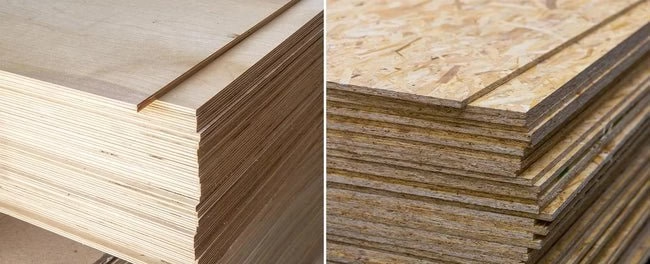
OSB features a characteristically textured surface. It is manufactured from rectangular wood strands arranged in cross-oriented layers. These strands are combined with heat-resistant adhesives and compressed under high pressure in large, continuous mats. This results in a dense, uniform panel with virtually no internal voids or soft spots.
2. Plywood
Conversely, Plywood is constructed from thin layers of wood veneer peeled from logs. These veneers are stacked with the grain of each layer perpendicular to the next—a process known as cross-lamination—and bonded with resin under a hot press. Plywood almost always consists of an odd number of layers to maintain structural balance around the center ply.
II. Comparative Pros and Cons
Each material possesses specific characteristics tailored to different functional needs.
| Feature | Oriented Strand Board (OSB) | Plywood |
| Size & Dimensions | Available in larger, longer panels. | Standardized sizes, limited large-format options. |
| Cost Efficiency | Generally more affordable and cost-effective. | Higher price point due to complex production. |
| Uniformity | Highly consistent with no internal voids. | May contain small core gaps or knots. |
| Fastener Retention | Moderate; shorter fibers offer less “grip.” | Excellent; long fibers hold screws/nails firmly. |
| Moisture Response | Edges swell significantly and rarely recover. | Swells less and typically returns to original thickness. |
| Weight | Heavier, requiring more labor for handling. | Lightweight and easier to maneuver on-site. |
III. Structural Integrity and Load-Bearing Capacity
From a structural engineering perspective, both OSB and Plywood are recognized as “wood structural panels” and perform similarly in most wall and roof sheathing applications.
However, a critical distinction exists in subflooring: Plywood subfloors are approximately 10% stiffer than OSB. Choosing OSB for flooring applications may occasionally lead to:
- Squeaking: Caused by microscopic floor movement over time.
- Surface Cracking: Increased risk of cracking for rigid surfaces like ceramic tiles.
- “Spongy” Feel: A slightly softer walking surface compared to the rigidity of plywood.
IV. Cost Analysis: OSB vs. Plywood
OSB remains the more economical choice due to two primary factors:
- Raw Material Utilization: OSB utilizes fast-growing, small-diameter trees or wood by-products, which are cheaper than the high-grade logs required for veneers.
- Production Efficiency: The continuous pressing process for OSB is less labor-intensive than the individual layering required for Plywood.
On average, a standard1220x2440mm (4×8 feet) sheet of Plywood can cost 40-60% more than an OSB sheet of the same thickness. However, for areas exposed to high moisture or requiring absolute floor rigidity, the additional investment in Plywood is often technically justified.
V. Conclusion from Unigo
The choice between OSB and Plywood depends entirely on your project’s priorities:
- If your goal is maximum cost-efficiency for wall sheathing or export packaging, OSB is the superior choice.
- If your requirement is long-term durability, moisture recovery, and floor stiffness, Plywood is the premium solution.
At Unigo, we provide both product lines manufactured to the highest technical standards, ensuring safety and performance for your construction needs.